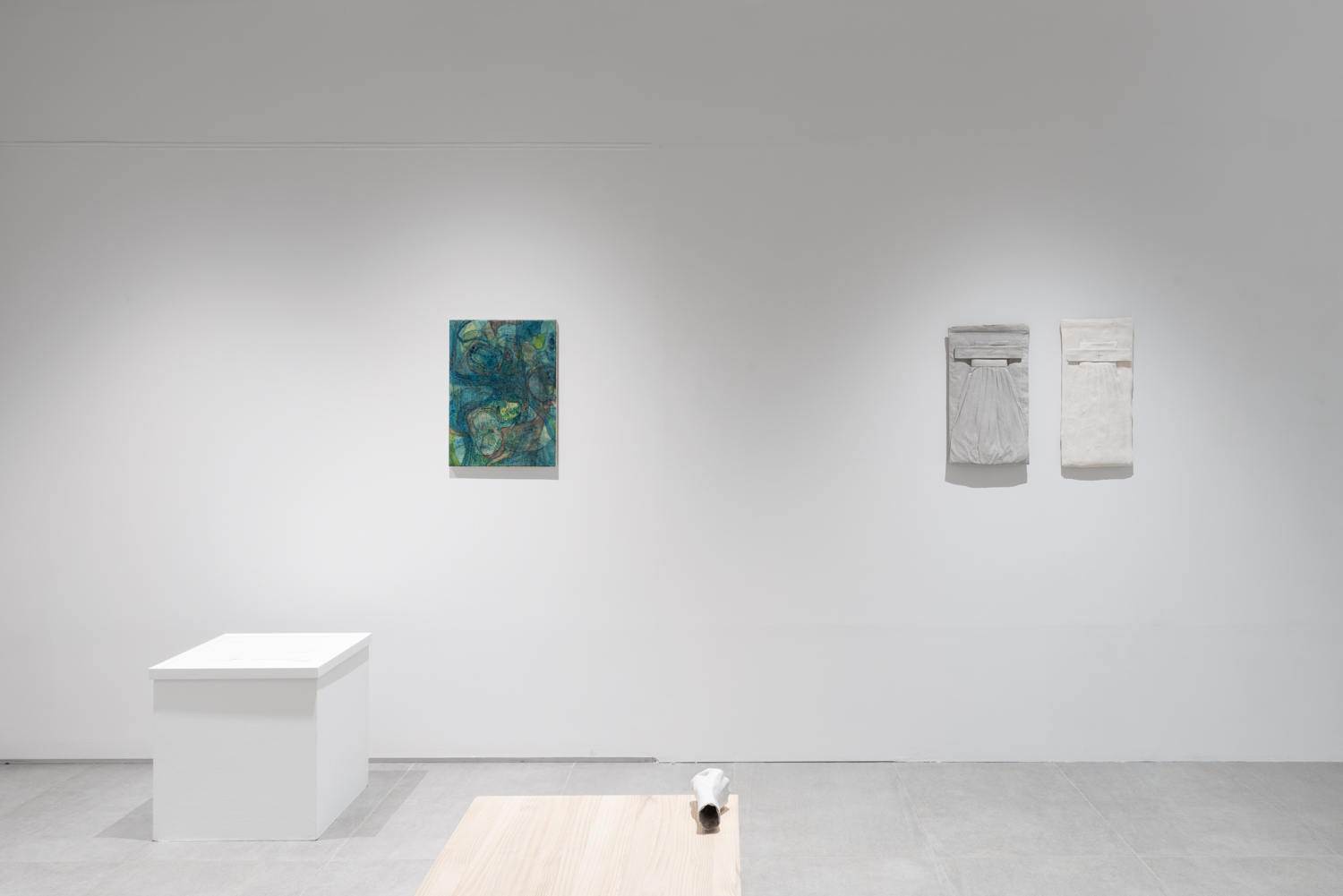
《husk》 begins from the two artists’ shared pursuit of conditions of existence that escape representation — bodies that are absent, and sensations that slip past perception. Both trace the time before form closes, the points where sensation and structure cross and collide. The residues of segmented bodies, pre-linguistic surfaces, and boundaries between unstable sensation and cognition form the lowest strata of their sculptural inquiry. Here, form remains suspended rather than complete, and each work hesitates or slides at the threshold of consciousness. The artists follow how meaning is made or forgotten, and how it can be summoned and reconfigured once again.
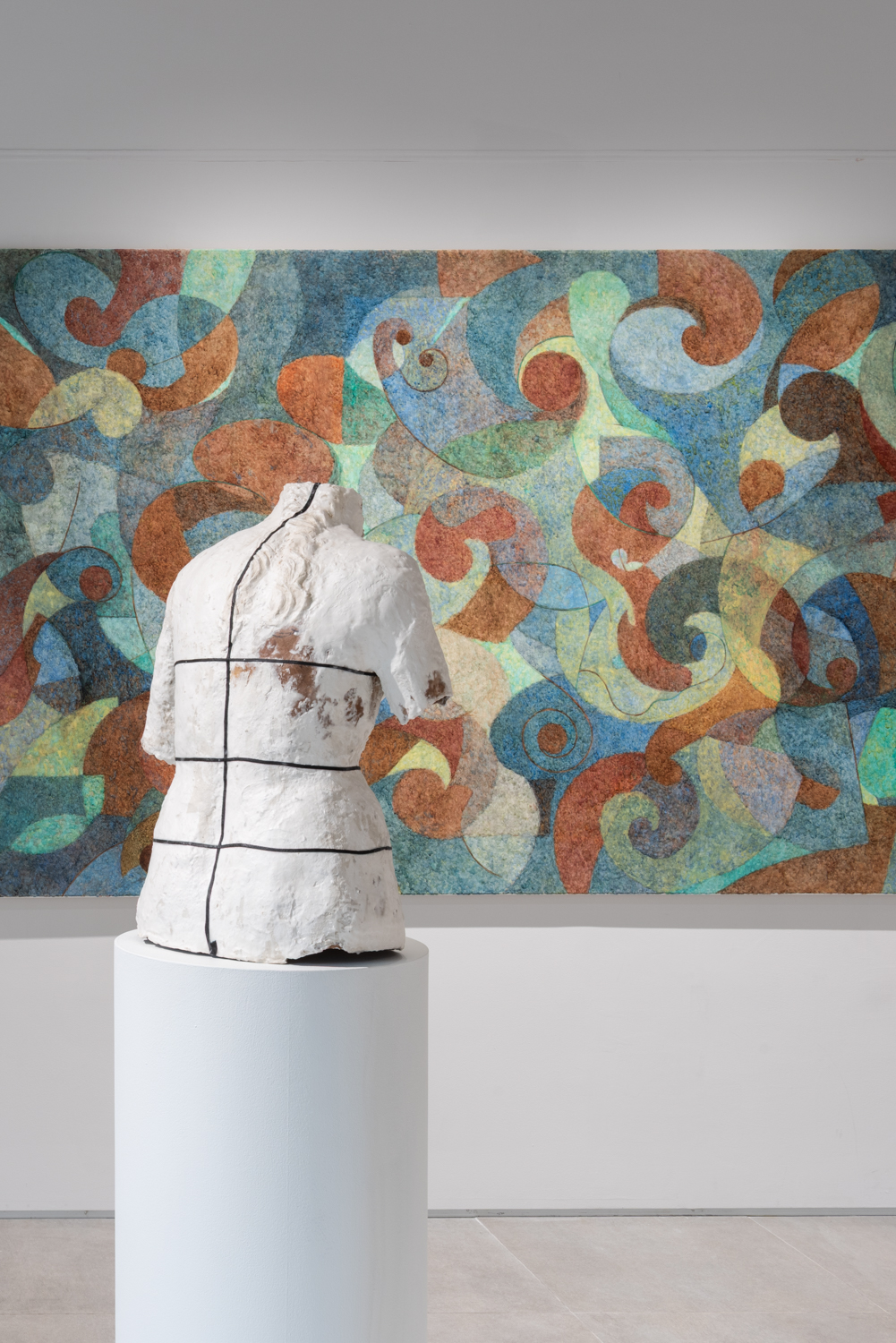
Changhyun Lee’s sculptural practice begins with revisiting the fragmented realities of the body embedded — and often erased — within structured histories. Rather than reproducing a finished body, he recalls divided units such as the hand, back, or chest within the logic of tailoring. These fragments are not presented as frontal figures but as residues of something once whole. His chosen materials—paper, photosensitized fabric, scrap sheets, pattern paper—are remnants of function, bearing traces of time and labor. By assembling, layering, and touching them again, the artist builds a form that does not aim for completion. What he references is not the image of form itself, but the strata through which form takes shape—its sensory and structural conditions.
The 17th-century polychrome woodcarving technique encarnación, the Roman idealization of black bronze through white marble, and the rear lines and cutting logic of suit patterns each represent historical systems that organized the body—frameworks Lee persistently interrogates. For him, the hand is not a tool of creation but a material organ that retraces suppressed sensations and traces of labor. His hand moves not to produce results, but to rebuild what has been left unseen. The works deviate from the language of representation, exposing the contact surfaces behind final construction.
A torso lined with a suit’s back panel resists the ideal body; instead, it reveals seams and cuts that expose the absence of monumentality. The pleats of a skirt attached to the wall recall not the contour of a worn body but the folds, ironing, and pressure of domestic labor. Pattern fragments retain the logic of drafting yet do not constitute garments—they are preserved in deferment of form. They indicate not the figure itself but the structure beyond it. What matters to Lee is not how the body appears, but how its invisibility has been designed.
Rui Suzuki poses the same questions through a wholly different language. Working through repetition in watercolor, paper, drawing, and cutting, she focuses on the reactions that occur where form begins to emerge. Her paintings do not depict contours or scenes, but extend the subtle tremors produced between chromatic borders and perceptual pressure. Lines, planes, blanks, and dots interfere with one another; form remains unfixed even as structure takes shape. Rather than translating sensation into image, she allows it to articulate itself.
For Suzuki, form is not a representational technique but a way of witnessing how perception becomes a system through repetition. Watercolor, a medium governed by water, gravity, and pressure, carries temporal fluidity—a quality she consistently upholds. She does not reduce sensation to subject or message; instead, she constructs its strata through rhythm—of flow, contact, and overlap. Meaning remains suspended. The resulting images waver without direction, drifting in a pre-linguistic state of multiplicity.
Her process often begins with destruction—a return of the support to a perceptual surface. Prepared canvases are wiped, rubbed, and abraded before being reconstituted as grounds for watercolor. The transformed surface shifts from a plane that receives image to one that absorbs and mutates sensation.
Titles operate as a visible axis alongside painting. Composed from fragments of everyday language, they do not merge with the image but act as a margin within it. The minute negotiations between image, support, and text mediate the work’s structure. Time left on the surface unfolds like an ecosystem, forming an organic continuum.
Both artists trace unstable structures of perception in distinct ways—through the inversion of form and recognition, and through the remnants left by that reversal. 《husk》 follows these strata of contact, asking again about the bodily conditions that remain as residues of time.